Next: Many H-PAH interactions Up: Interaction potential Previous: Computational details and models Contents
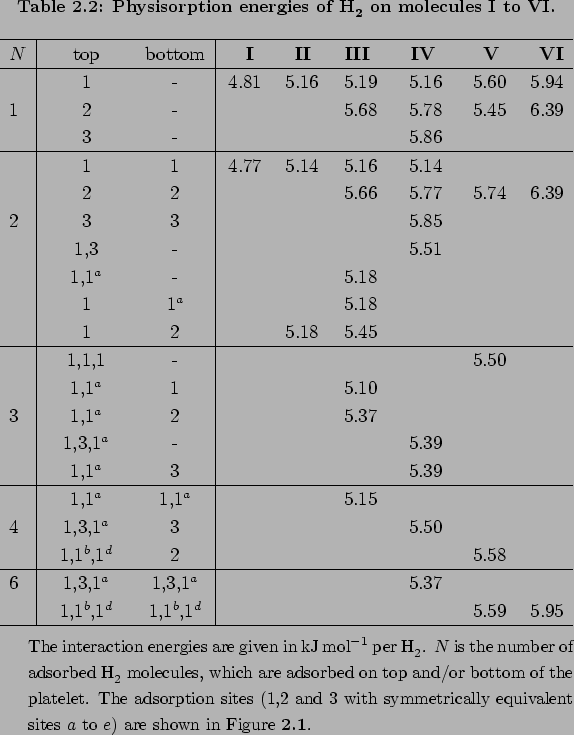
A main result of H2 PAHs series of calculations (shown on Fig. 2.1) is the presence of a correlation between the number of the hexagonal carbon rings and the H2PAH interaction (see Table 2.2).
In other words the interaction grows with the number of the closely situated hexagon rings.
For the H2benzene complex, the physisorption energy is found to be 4.8 kJ
PAHs series of calculations (shown on Fig. 2.1) is the presence of a correlation between the number of the hexagonal carbon rings and the H2PAH interaction (see Table 2.2).
In other words the interaction grows with the number of the closely situated hexagon rings.
For the H2benzene complex, the physisorption energy is found to be 4.8 kJ mol
mol , while for the central ring of coronene it is 6.4 kJmol.
All other sites studied here give physisorption energies between these values.
Moreover, these series of calculations show that the interaction increases with the size of the PAH.
On the other hand, a ring situated at larger distance contributes less to the total H2PAH energy interaction.
The latter effect can be clearly observed by changing the adsorption site (ring) of H2 on linear PAH molecules like naphthalene, anthracene and pentacene (see Tab. 2.2).
1.0
, while for the central ring of coronene it is 6.4 kJmol.
All other sites studied here give physisorption energies between these values.
Moreover, these series of calculations show that the interaction increases with the size of the PAH.
On the other hand, a ring situated at larger distance contributes less to the total H2PAH energy interaction.
The latter effect can be clearly observed by changing the adsorption site (ring) of H2 on linear PAH molecules like naphthalene, anthracene and pentacene (see Tab. 2.2).
1.0
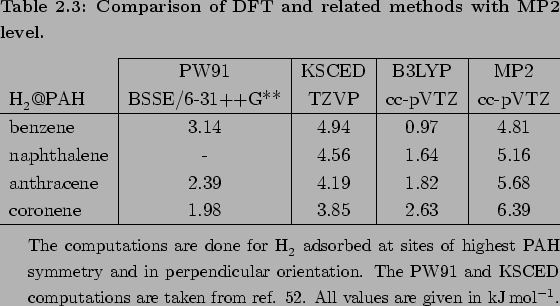
PAH interaction by Tran et al. [52] shows that there is an attractive interaction caused by
weakly overlapping densities.
The interaction energies are slowly varying between at 3.8 and 4.9 kJmol, but they are not size-dependend within KSCED and DFT.
This is because the available implementations of these theories to present-day are restricted by exchange-correlation functionals which do not include the dispersion interaction properly.
benzene interaction within these methods is even stronger than for some larger PAHs, which is in contradiction to the MP2 results.
This can be easily understood if one consider a missing long-range part of the energy interaction.
In contrast to GGA-DFT, the hybrid B3LYP/cc-pVTZ calculations show the correct trend, however, they strongly underestimate the interaction energy.
Hence the KSCED and DFT methods give us information for the attractive abilities of the adsorption site itself.
Combining that information with the MP2 calculations it can be stated that the physisorption energy depends not only on the size of the PAH, but also on the H2 adsorption site of the molecule.
Thus the stronger interaction with the non-central rings of triphenylene (see Table 2.2) can be explained with their stronger attraction capabilities due to a reorganisation of the electron  -system.
However, physisorption sites such as in triphenylene are considered to be only typical for the edge of a graphene structure.
If no defects are considered, their contribution to the H2graphene interaction energy will vanish far from the edges since the properties of the structure become uniform.
Therefore triphenylene, which has a quite special topology compared to the other PAHs, can be excluded form the H2PAHs series.
Thus, considering only the highest H2PAHs interaction energies, a general trend can be observed:
The more neighbouring rings the adsorption site has the stronger is its interaction.
On the other hand sites with identical number and position of first neighbours have very similar interaction energies.
In particular, the outer rings of naphthalene, anthracene and pentacene, all having only one neighbour ring, differ by not more then 0.03 kJmol. (see Table 2.2)
The central ring of anthracene and the second ring of pentacene, both having two neighbours at the same positions, differ by 0.1 kJmol.
Moreover in Table 2.2 it can be seen that physisorption energy converges against a saturation for a linear chain of rings (benzene, anthracene, pentacene).
Thus central site of coronene has a physisorption energy of 6.39 kJmol, which is expected to be slightly weaker than the interaction
energy of H2 with graphene.
This indicates that H2-PAH interaction approaches a limit with increasing size of the PAH size, which is the H2-graphene (PAH with infinite size) interaction energy.
So far it can be assumed that trends found for small PAHs holds as well for larger ones, in particular for those which are contiguous or have a convex shape, like the nano-scale graphene platelets.
This way the physisorption energy of a H2 molecule, adsorbed perpendicular to the sheet on top of a ring centre, at a distance 3.1 Å between PAH sheet and H2 centre, can be estimated by a simple equation.
This can be motivated by the following facts:
-system.
However, physisorption sites such as in triphenylene are considered to be only typical for the edge of a graphene structure.
If no defects are considered, their contribution to the H2graphene interaction energy will vanish far from the edges since the properties of the structure become uniform.
Therefore triphenylene, which has a quite special topology compared to the other PAHs, can be excluded form the H2PAHs series.
Thus, considering only the highest H2PAHs interaction energies, a general trend can be observed:
The more neighbouring rings the adsorption site has the stronger is its interaction.
On the other hand sites with identical number and position of first neighbours have very similar interaction energies.
In particular, the outer rings of naphthalene, anthracene and pentacene, all having only one neighbour ring, differ by not more then 0.03 kJmol. (see Table 2.2)
The central ring of anthracene and the second ring of pentacene, both having two neighbours at the same positions, differ by 0.1 kJmol.
Moreover in Table 2.2 it can be seen that physisorption energy converges against a saturation for a linear chain of rings (benzene, anthracene, pentacene).
Thus central site of coronene has a physisorption energy of 6.39 kJmol, which is expected to be slightly weaker than the interaction
energy of H2 with graphene.
This indicates that H2-PAH interaction approaches a limit with increasing size of the PAH size, which is the H2-graphene (PAH with infinite size) interaction energy.
So far it can be assumed that trends found for small PAHs holds as well for larger ones, in particular for those which are contiguous or have a convex shape, like the nano-scale graphene platelets.
This way the physisorption energy of a H2 molecule, adsorbed perpendicular to the sheet on top of a ring centre, at a distance 3.1 Å between PAH sheet and H2 centre, can be estimated by a simple equation.
This can be motivated by the following facts:
 , as already proposed by London.[33]
 , and the remainder describes the dispersion interaction.
Thus if H2 is adsorbed normal to the PAH on top of a hexagonal ring,
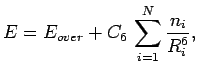
the interaction energy can be approximated with
, and the remainder describes the dispersion interaction.
Thus if H2 is adsorbed normal to the PAH on top of a hexagonal ring,
the interaction energy can be approximated with
 is the number of rings in the PAH, and
  is the number of equivalent rings which have all the same distance
  to the molecular mass-centre of H2.
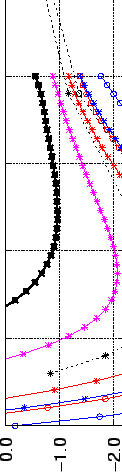
If the MP2 energies from Table 2.2 are plotted against the term
to the molecular mass-centre of H2.
If the MP2 energies from Table 2.2 are plotted against the term
 (as shown in the included plot in Figure 2.5), the resulting
 |
 kJ Å
kJ Å mol and the intercept
0.52.2
mol and the intercept
0.52.2
 kJmol, with correlation coefficient of the regression
  .
While this correlation is not good enough to compute quantitatively the physisorption energy of PAHs with H2, it is still satisfactory
for the interpolation to graphene and to discuss the size effect of the interaction.
The E
.
While this correlation is not good enough to compute quantitatively the physisorption energy of PAHs with H2, it is still satisfactory
for the interpolation to graphene and to discuss the size effect of the interaction.
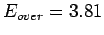
The E value, which is attributed to weakly overlapping densities, is in perfect
agreement with its determination by Tran et al. [52] and the CCSD(T) level of theory (Tab. 2.1).
Application of Eq. 2.1 to the PAHs computed in this study gives a maximum error of 0.3 kJmol with respect to
the MP2 results.
value, which is attributed to weakly overlapping densities, is in perfect
agreement with its determination by Tran et al. [52] and the CCSD(T) level of theory (Tab. 2.1).
Application of Eq. 2.1 to the PAHs computed in this study gives a maximum error of 0.3 kJmol with respect to
the MP2 results.
As shown in Figure 2.5, the dispersion interaction, and hence the total interaction, will
reach a limit for larger platelet sizes, as the number of rings increases quadratically with the platelet radius,
while each contribution is divided by  . Saturation is reached for PAH diameters of
  15 Å,
and the graphene-H2 interaction is only 0.8 kJmol stronger than that of coronene with H2.
The total interaction energy for the extrapolated graphene using Eq. 2.1 thus reach a
value of 7.2 kJmol per H2.
This shows that for large PAHs and graphene both contributions, dispersion interaction and overlapping density,
are both very important to describe the physisorption correctly.
15 Å,
and the graphene-H2 interaction is only 0.8 kJmol stronger than that of coronene with H2.
The total interaction energy for the extrapolated graphene using Eq. 2.1 thus reach a
value of 7.2 kJmol per H2.
This shows that for large PAHs and graphene both contributions, dispersion interaction and overlapping density,
are both very important to describe the physisorption correctly.