Next: Extrapolation to graphene surface Up: Interaction potential Previous: Interaction potential Contents
H2 molecules physisorbed on polyaromatic hydrocarbons (PAHs) have been chosen as model systems to evaluate the parameters in Eq. 1.14.
Since the dispersion interaction vanishes with a term of  , it is expected that relatively small PAHs can depict the H2
 graphene interaction accurately enough.
The interaction energy is computed for H2 physisorbed on PAHs with different number of carbon atoms.
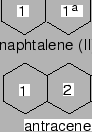
The smallest PAH is benzene (1 ring and 6 Catoms) and the largest is coronene (7 rings and 24C atoms) (see Fig. 2.1).
graphene interaction accurately enough.
The interaction energy is computed for H2 physisorbed on PAHs with different number of carbon atoms.
The smallest PAH is benzene (1 ring and 6 Catoms) and the largest is coronene (7 rings and 24C atoms) (see Fig. 2.1).
 0.01 Å) has been found for the parameters derived with higher (MP2) and lower (DFT) levels of theory.
The DFT optimised geometry parameters of the PAHs have been used in the forthcoming calculations.
However, for the H2PAH complexes, a different approach has been taken.
Although, DFT performs rather well for covalent atomic structures, it is not valid for complexes where the interaction between the residues is based on dispersion forces.
In this case, ab initio methods accounting for electronic correlations are the better choice.
The H2PAH distance and binding energy are therefore determined using
0.01 Å) has been found for the parameters derived with higher (MP2) and lower (DFT) levels of theory.
The DFT optimised geometry parameters of the PAHs have been used in the forthcoming calculations.
However, for the H2PAH complexes, a different approach has been taken.
Although, DFT performs rather well for covalent atomic structures, it is not valid for complexes where the interaction between the residues is based on dispersion forces.
In this case, ab initio methods accounting for electronic correlations are the better choice.
The H2PAH distance and binding energy are therefore determined using post Hartree-FockMP2 theory2.1.
Due to incompleteness of the basis sets, an overestimation of the binding energies is expected.
Therefore basis set superposition error (BSSE) corrections are added using
the counterpoise method [49].
To estimate the performance of the different basis sets, the H2C6H6 complex has been used.
The moleculemolecule potential energy surface has been evaluated by scanning the distance between the molecular mass centres.
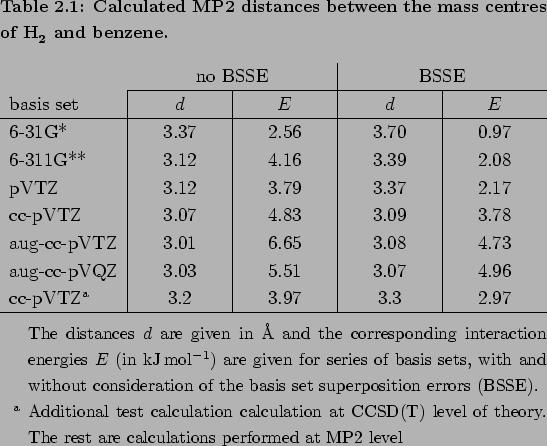
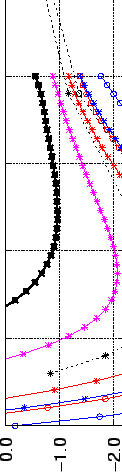
Then, the basis sets have been gradually increased from 6-31G* up to aug-cc-pVQZ by reaching almost the basis set limit where the difference between the non-corrected and the BSSE corrected values is only 0.6 kJ mol
mol (see Fig. 2.2).
 |
C6H6 distance, the interaction energy is extremely sensitive to the basis set at the MP2 level.
Nevertheless, by a fortuitous error cancellations the results at MP2/cc-pVTZ level give relatively good values.
They closely mimic the higher level calculations (CCSD(T) and MP2/aug-cc-pVQZ), both at the global minimum and in the asymptotic region (see Tab. 2.1 and Fig. 2.2).
Because MP2/cc-pVTZ calculations are significantly less expensive, this basis set is used for the potential energy surface (PES) characterisation in larger systems. (up to H2coronene see Fig. 2.1)
This basis set has been used as well for test calculations with coupled-cluster treatment of the electron correlation.
In the global PES minimum, H2 has been found to be aligned along the C symmetry (perpendicular orientation see Fig. 2.3 Left) axis of benzene at a distance 3.1 Å between the mass-centres of H2 and C6H6.
 long-range behaviour (Fig. 2.2).
More sophisticated correlation treatment (CCSD(T)/cc-pVTZ) reduces the H2benzene interaction by 0.9 kJmol [50] (20%) comparing with MP2/cc-pVTZ values, whereas the geometry remains essentially unchanged.
Similar trends are observed for the other two high symmetry orientations (see Fig. 2.3 Middle and Right) of the hydrogen with respect to a benzene molecule.
The energy profiles of these two orientations are indistinguishable at this level of calculations and for readability only one of them is shown on Figure 2.4.
Besides the surprisingly good performance found for cc-pVTZ basis set the calculations and the counter poise procedure shows that there is no significant energetic difference between different orientations (normal and parallel).
long-range behaviour (Fig. 2.2).
More sophisticated correlation treatment (CCSD(T)/cc-pVTZ) reduces the H2benzene interaction by 0.9 kJmol [50] (20%) comparing with MP2/cc-pVTZ values, whereas the geometry remains essentially unchanged.
Similar trends are observed for the other two high symmetry orientations (see Fig. 2.3 Middle and Right) of the hydrogen with respect to a benzene molecule.
The energy profiles of these two orientations are indistinguishable at this level of calculations and for readability only one of them is shown on Figure 2.4.
Besides the surprisingly good performance found for cc-pVTZ basis set the calculations and the counter poise procedure shows that there is no significant energetic difference between different orientations (normal and parallel).
|
1.5 kJmol) compared with perpendicular orientation and no difference when H2 rotates in the plane complanar to the benzene plane.
However, at higher temperatures these different orientations are expected to be indistinguishable (see section 1.1.4).
Further on, for the sake of simplicity, the conclusions are based only on the models in which H2 is perpendicularly oriented with respect to the plane of PAHs.
The distance between the mass centres of the residues in the H2-PAH complexes is found to be 3.08 Å.
A full geometry optimisation at the MP2/cc-pVTZ level for I, II, and III complexes (see Fig. 2.1) shows that the PAH size have negligible effect on the H2-PAH bond length.
Neither has the adsorption site of the PAH, as long as the hydrogen molecule is positioned on top of the ring centre.
The covalent bond lengths in the three H2-PAHs (I, II, and III) complexes change within 0.006 Å.
Whereas, the distance between H2 and PAHs in these benchmark complexes, differs by less than 0.01 Å.
The interaction energy in the ground state, estimated by the PES scan underestimate the full optimisation energy by less than 0.02 kJmol.
In order to extend the grid of the potential energy surface, H2 coordinates other than those laying on the C axis of benzene, have been investigated as well.
It was found that for sites as on-top-of-atoms and on-top-of-bonds hydrogen experience slightly weaker interaction than on the top of the benzene's centre (by 1.2 kJmol at MP2/cc-pVTZ level).
For larger systems as coronene these values have been found to be even smaller (0.8 kJmol), which indicates a softening of the potential with the increase of the sorbent surface.
These numbers are in agreement with reported results at various theoretical levels [51,52,53].
To avoid unphysical conclusions, all approximations and models employed here, except the MP2 theory, are chosen to underestimate the interaction, so that final physisorption energy should be slightly lower.
Because in larger PAHs the  - system does not change dramatically its nature the physisorption is assumed to obey the same trends as with benzene ring.
Therefore, the larger H2-PAH complexes are build according to the following assumptions:
the strongest interaction is on top of the hexagon ring's centre and the hydrogen molecule is oriented along the C axis.
The validity of these assumptions has been proven by calculations repeathing the H2-benzene procedure for naphthalene and anthracene.
Thus, knowing the performance and the errors which can be introduced with MP2/cc-pVTZ level of calculations and the basic trends for the smaller systems of the series (see Fig. 2.1), the building of larger models is done in the following manner:
a) optimise the building blocks of the H2PAH complex by using B3LYP/6-31G* level of theory,
b) build the complexes with different number of hydrogen molecules situated at the centres of symmetrically distinguishable
benzene rings and c) calculate the energy of interaction at the equilibrium distance (3.08 Å).
- system does not change dramatically its nature the physisorption is assumed to obey the same trends as with benzene ring.
Therefore, the larger H2-PAH complexes are build according to the following assumptions:
the strongest interaction is on top of the hexagon ring's centre and the hydrogen molecule is oriented along the C axis.
The validity of these assumptions has been proven by calculations repeathing the H2-benzene procedure for naphthalene and anthracene.
Thus, knowing the performance and the errors which can be introduced with MP2/cc-pVTZ level of calculations and the basic trends for the smaller systems of the series (see Fig. 2.1), the building of larger models is done in the following manner:
a) optimise the building blocks of the H2PAH complex by using B3LYP/6-31G* level of theory,
b) build the complexes with different number of hydrogen molecules situated at the centres of symmetrically distinguishable
benzene rings and c) calculate the energy of interaction at the equilibrium distance (3.08 Å).