Next: Approximations and inaccuracies of Up: Methodology of calculations Previous: Methodology of calculations Contents
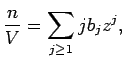
 is the number of particles,
  is the volume of the system, and
 is the activity of the gas, where
  is the gas fugacity.
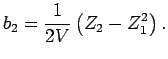
The first two cluster integrals
is the gas fugacity.
The first two cluster integrals  in the expansion 1.5 are given by[35]:
 is additive with the
  -particle contribution to the interaction energy
  , the
, the  configuration integral Z
 is given by[35]:
is slowly varying compared to the two-particle interaction energy
is given by[35]:
is slowly varying compared to the two-particle interaction energy  ( decays to zero at large distances) and is isotropic, the integral
1.9 can be replaced by:
is approximately given by:
=0;
( decays to zero at large distances) and is isotropic, the integral
1.9 can be replaced by:
is approximately given by:
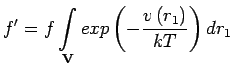
=0;  ), the integral in Eq.1.13 is the classical equilibrium constant for the ideal gas adsorption.
In order to estimate the real-gas adsorption capacity of a nanostructure, there are two quantities required:
On one hand this is the ideal gas adsorption constant K
), the integral in Eq.1.13 is the classical equilibrium constant for the ideal gas adsorption.
In order to estimate the real-gas adsorption capacity of a nanostructure, there are two quantities required:
On one hand this is the ideal gas adsorption constant K .
On the other hand the estimation of the accessible volume within the structure
.
On the other hand the estimation of the accessible volume within the structure  , with a slowly varying adsorption potential.
Given the external pressure
, with a slowly varying adsorption potential.
Given the external pressure  , the effective pressure of the absorbed gas inside the nanostructure
  the internal pressure is
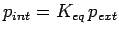 .
The experimental real gas equation of state, with the internal pressure gives all further information on the guesthost system, including the volumetric and the gravimetric storage densities.
Thus, despite the ``frozen'' host structure used in the simulation, H2 gas properties are given by the experimental equation of state[36] which covers the conditions for a conventional H2-storage applications.
.
The experimental real gas equation of state, with the internal pressure gives all further information on the guesthost system, including the volumetric and the gravimetric storage densities.
Thus, despite the ``frozen'' host structure used in the simulation, H2 gas properties are given by the experimental equation of state[36] which covers the conditions for a conventional H2-storage applications.
Lyuben Zhechkov 2007-09-04

![$\displaystyle \jot9pt
Z_{N}=\mathop{\int}_{\mathbf{V}} exp\left\{-\frac{1}{kT}\...
...r_{i}\right)
+u_{N}\left(r_{1}...r_{N}\right)\right]\right\}\,dr_{1}...dr_{N} .$](img68.png)
![$\displaystyle \jot9pt
b_{2}=\frac{1}{2V}\mathop{\int}_{\mathbf{V}}exp\left\{-\f...
...p\left[-\frac{1}{kT}u_{2}\left(r_{1}-r_{2}\right)\right]-1\right\}dr_{1}dr_{2}.$](img69.png)
![$\displaystyle \jot9pt
b_{2}\approx\frac{1}{2V}\mathop{\int}_{\mathbf{V}}exp\lef...
...{2}\left\{exp\left[-\frac{u_2
\left(r_{12}\right)}{kT}\right]-1\right\}dr_{12}.$](img71.png)
![$\displaystyle \jot9pt
b_{2}\approx\frac{1}{2V}{\left\{
\mathop{\int}_{\mathbf{V...
...{2}\left\{exp\left[-\frac{u_2
\left(r_{12}\right)}{kT}\right]-1\right\}dr_{12}.$](img72.png)


![$\displaystyle {\left\{\frac{f}{kT}
\mathop{\int}_{\mathbf{V}}exp\left[-\frac{v\left(r_{1}\right)}{kT}\right]dr_{1}\right\}}$](img75.png)

![$\displaystyle \int^{\infty}_{0}4{\pi}r_{12}^{2}\left\{exp\left[-\frac{u_2
\left...
...t}_{\mathbf{V}}exp\left[-\frac{v\left(r_{1}\right)}{kT}\right]dr_{1}\right\}}^2$](img77.png)