Next: Graphene spacers Up: Physisorption on graphene Previous: Mono- and double layer Contents
 H2 interactions are strongly repulsive at intermolecular distance
  2.5 Å[54,55].
For graphene slit pores a higher H2 guest densities are expected (
2.5 Å[54,55].
For graphene slit pores a higher H2 guest densities are expected ( 0.01 gcm
 ) therefore, hydrogen can no longer be treated as an ideal gas.
Although, it is possible to simulate the high-density H2-graphene system directly, for example using the grand canonical path integral Monte Carlo approach[24,61,62,63,64], such calculations are rather laborious and may be hard to interpret.
At the same time, for slowly varying potentials and low gas density, the adsorption free energy of an ideal gas is a good approximation to the adsorption free energy of the real gas.
However, at higher density the ideal gas approximation would require a correction because of the repulsion forces in the real gas.3.1The estimation of the corrections due to H2 nonideality at higher densities from an experimental equation of state [36] is made as follows:
Given the external H2 pressure
) therefore, hydrogen can no longer be treated as an ideal gas.
Although, it is possible to simulate the high-density H2-graphene system directly, for example using the grand canonical path integral Monte Carlo approach[24,61,62,63,64], such calculations are rather laborious and may be hard to interpret.
At the same time, for slowly varying potentials and low gas density, the adsorption free energy of an ideal gas is a good approximation to the adsorption free energy of the real gas.
However, at higher density the ideal gas approximation would require a correction because of the repulsion forces in the real gas.3.1The estimation of the corrections due to H2 nonideality at higher densities from an experimental equation of state [36] is made as follows:
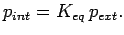
Given the external H2 pressure  , and the equilibrium constant
  obtained from the ideal gas simulation, the effective ``internal'' H2 pressure
  is calculated as
and the experimental H2 equation of state[36], the molar volume
is calculated as
and the experimental H2 equation of state[36], the molar volume  is obtained.
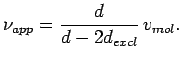
The apparent molar volume of H2, characterising volumetric efficiency of the storage system is then given by
is obtained.
The apparent molar volume of H2, characterising volumetric efficiency of the storage system is then given by
 |
(3.2) |
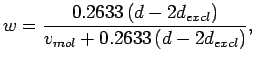 |
(3.3) |
is in
 and
and  ,
,  are in Å.
The structural prefactor
are in Å.
The structural prefactor
 Å is calculated from the fixed in-plane carboncarbon distance
  , the atomic masses
  and
and  of hydrogen and carbon, and the Avogadro constant
  . Calculated internal pressure, volumetric
and mass weight densities for representative temperatures, and
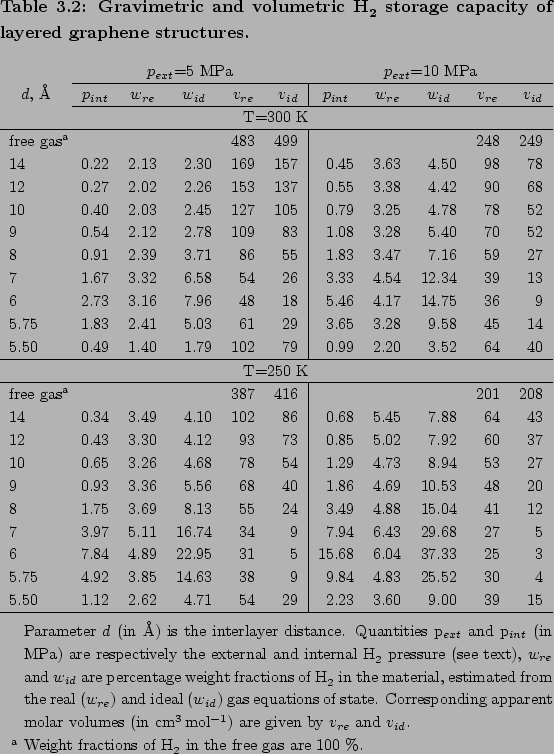
external H2 pressures are collected in Table 3.2 and Fig. 3.2.
H2 interaction potentials, treatment of the quantum effects for H2H2 interactions, and the associated convergence issues.
It is important to understand the approximations made in the nonideal gas estimation of the storage capacities
. Calculated internal pressure, volumetric
and mass weight densities for representative temperatures, and
external H2 pressures are collected in Table 3.2 and Fig. 3.2.
H2 interaction potentials, treatment of the quantum effects for H2H2 interactions, and the associated convergence issues.
It is important to understand the approximations made in the nonideal gas estimation of the storage capacities  and
and  . Eq. 3.1 requires the use of fugacities
  , rather than gas pressures
  .
As the
.
As the  ratio decreases with pressure (at temperatures and pressures considered presently), Eq. 3.1 is expected to underestimate the internal pressure .
At the same time, using the free gas equation of state to calculate the molar volume neglects changes in H2H2 radial distribution function due to the adsorption potential and, thus, overestimates the compressibility of the guest.
Although these two defects may be expected to partially offset each other, the overall nonideality correction is at best semiquantitative.
To illustrate the effect of the nonideality corrections, Table 3.2 also includes
ratio decreases with pressure (at temperatures and pressures considered presently), Eq. 3.1 is expected to underestimate the internal pressure .
At the same time, using the free gas equation of state to calculate the molar volume neglects changes in H2H2 radial distribution function due to the adsorption potential and, thus, overestimates the compressibility of the guest.
Although these two defects may be expected to partially offset each other, the overall nonideality correction is at best semiquantitative.
To illustrate the effect of the nonideality corrections, Table 3.2 also includes  and
and  values calculated from the ideal gas equation of state.
When the real and ideal gas values are close, the residual error in the storage capacity is determined by the remaining uncertainties in the ab initio H2graphene interaction potential and the corresponding
values calculated from the ideal gas equation of state.
When the real and ideal gas values are close, the residual error in the storage capacity is determined by the remaining uncertainties in the ab initio H2graphene interaction potential and the corresponding  fit.
Based on the basis set and method convergence, the estimation of the error is about
fit.
Based on the basis set and method convergence, the estimation of the error is about  25 % in and .
When the real and ideal gas values deviate significantly from each other, the real gas result is clearly more reliable but should still be treated only as a semiquantitative estimate.
The spatial distribution of molecular hydrogen adsorbed on graphene is very delocalised (see Fig. 3.3).
25 % in and .
When the real and ideal gas values deviate significantly from each other, the real gas result is clearly more reliable but should still be treated only as a semiquantitative estimate.
The spatial distribution of molecular hydrogen adsorbed on graphene is very delocalised (see Fig. 3.3).
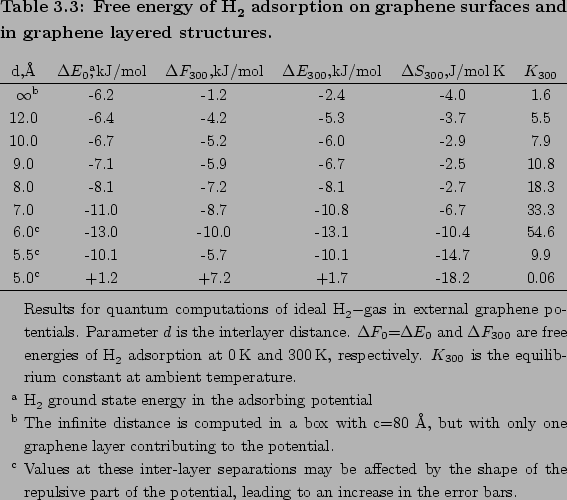
 mol) H2graphene free reaction energy at 300 K (see Table 3.3), mainly because of the entropic contribution (
 )
=exp(
)
=exp(
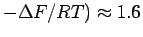 .
In other words, at room temperature a graphene surface increases the H2 abundance by only
.
In other words, at room temperature a graphene surface increases the H2 abundance by only  60 % when an increase of at least 700 times is necessary in order to make the storage density of H2 enough for conventional usage [2].
The enhancement factor however, does not significantly change at lower temperatures (Fig. 3.4) or higher pressures.
Considering the volume taken up by graphene itself, graphene surfaces are unsuitable for practical H2 storage.
mol have been reported for H2 inside carbon nanotube tips [53].
The calculated hereby quantum-mechanical physisorption free energies are for interlayer distances (), between two graphene layers ranging from 4 to 14 Å.
As can be seen from the results in Table 3.3, at separations above 7 Å the zero-temperature enthalpy of the H2graphene interaction is very similar for bi- and monolayer structures [52].
Even at these separations, the free energy is strongly affected by the presence and position of the second layer (Table 3.3 and Fig. 3.5).
10 kJmol for an interlayer distance of 6 Å.
For smaller separations, the exchange repulsion reduces the free energy considerably (Fig. 3.5), which becomes positive for interlayer separations
60 % when an increase of at least 700 times is necessary in order to make the storage density of H2 enough for conventional usage [2].
The enhancement factor however, does not significantly change at lower temperatures (Fig. 3.4) or higher pressures.
Considering the volume taken up by graphene itself, graphene surfaces are unsuitable for practical H2 storage.
mol have been reported for H2 inside carbon nanotube tips [53].
The calculated hereby quantum-mechanical physisorption free energies are for interlayer distances (), between two graphene layers ranging from 4 to 14 Å.
As can be seen from the results in Table 3.3, at separations above 7 Å the zero-temperature enthalpy of the H2graphene interaction is very similar for bi- and monolayer structures [52].
Even at these separations, the free energy is strongly affected by the presence and position of the second layer (Table 3.3 and Fig. 3.5).
10 kJmol for an interlayer distance of 6 Å.
For smaller separations, the exchange repulsion reduces the free energy considerably (Fig. 3.5), which becomes positive for interlayer separations  5 Å.
The thermodynamics of the H2graphene system at shorter separations is purely repulsive [66].
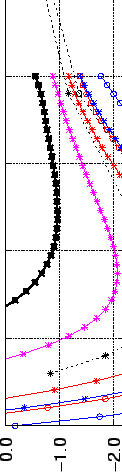
The calculated equilibrium constant shows a sharp ``peak'' at 67 Å (Fig. 3.2 Left).
Consequently, experimental fine-tuning of should be taken with care; too small separation could readily lead to a collapse in the adsorption free energy.
At ambient conditions (
5 Å.
The thermodynamics of the H2graphene system at shorter separations is purely repulsive [66].
The calculated equilibrium constant shows a sharp ``peak'' at 67 Å (Fig. 3.2 Left).
Consequently, experimental fine-tuning of should be taken with care; too small separation could readily lead to a collapse in the adsorption free energy.
At ambient conditions ( K,
K,  MPa) the maximum estimate of the present calculations is for equilibrium constant of 30 for a graphenegraphene interlayer distance of 7 Å.
The very favourable adsorption free energies for
MPa) the maximum estimate of the present calculations is for equilibrium constant of 30 for a graphenegraphene interlayer distance of 7 Å.
The very favourable adsorption free energies for  67 Å effectively creates a ``nanopump'', increasing the internal H2 pressure inside the layered structure (see Table 3.2).
As a result, the target of 62 kg/m
67 Å effectively creates a ``nanopump'', increasing the internal H2 pressure inside the layered structure (see Table 3.2).
As a result, the target of 62 kg/m (31 cm/mol) volumetric storage density, set by the FCVT[4], can be approached at a moderate external H2 pressure (10 MPa) even at room temperature.
At the same time, the simulations indicate that a pure carbon based (graphene or graphite like) storage system cannot achieve the FCVT Project[4] gravimetric storage target (6.0 wt % H2) at room temperature and moderate pressures (up to 10 MPa).
(31 cm/mol) volumetric storage density, set by the FCVT[4], can be approached at a moderate external H2 pressure (10 MPa) even at room temperature.
At the same time, the simulations indicate that a pure carbon based (graphene or graphite like) storage system cannot achieve the FCVT Project[4] gravimetric storage target (6.0 wt % H2) at room temperature and moderate pressures (up to 10 MPa).
Due to the increasingly nonideal behaviour of H2 at high internal pressures, room-temperature storage capacity of these hypothetical systems is limited to 23 wt % at 5 MPa, and to 34 wt % at 10 MPa.
Although not yet achieving the FCVT[4] target, this storage capacity is already competitive with best known physisorption substrates.
Similar room-temperature gravimetric storage capacities have been calculated for a wide range of interlayer spacing (712 Å; see Fig. 3.2), which should simplify practical design of the storage material.
Caution should be applied in interpreting the results of the simulations concerning small interlayer distances ( 9 Å).
At low pressures, van der Waals close-packing arguments suggest that at most two H2 monolayers (6.6 wt %) can fit between the graphene layers separated by = 9 Å.
For = 6 Å, just one monolayer can fit in the structure, indicating a maximum H2 storage capacity of 3.3 wt %.
Although this argument holds at low pressures, the large adsorption free energy calculated for small interlayer spacing can drive the internal pressure beyond 2 kbar (1 bar = 100 kPa), even at moderate external pressures (Table 3.2).
In the free hydrogen gas, the density at such pressures exceeds the close-packing limit for hydrogen gas [36].
At the same time, the approach to H2H2 interactions is crude, so that the pronounced maximum in H2 storage capacity found at interlayer spacing 6 Å
9 Å).
At low pressures, van der Waals close-packing arguments suggest that at most two H2 monolayers (6.6 wt %) can fit between the graphene layers separated by = 9 Å.
For = 6 Å, just one monolayer can fit in the structure, indicating a maximum H2 storage capacity of 3.3 wt %.
Although this argument holds at low pressures, the large adsorption free energy calculated for small interlayer spacing can drive the internal pressure beyond 2 kbar (1 bar = 100 kPa), even at moderate external pressures (Table 3.2).
In the free hydrogen gas, the density at such pressures exceeds the close-packing limit for hydrogen gas [36].
At the same time, the approach to H2H2 interactions is crude, so that the pronounced maximum in H2 storage capacity found at interlayer spacing 6 Å  7.5 Å should be considered only as a tantalising possibility.
Confirming or disproving its existence would require further, more elaborate simulations or experiments.
7.5 Å should be considered only as a tantalising possibility.
Confirming or disproving its existence would require further, more elaborate simulations or experiments.
The qualitative difference in the H2 storage capacity of mono- and bilayer graphene is easily understood by comparing the density of states (DOS) in Fig. 3.6
 |
The estimated limit of accuracy of these calculations at  8 Å is within 25 % (see Chapter 1).
Even considering this large margin of error, the conclusion is that an H2 storage enhancement material approaching, or possibly even exceeding, the FCVT[4] specification can be produced by encapsulating molecular hydrogen in graphene layers with an appropriate interlayer spacing.
The significant dependence of the equilibrium constant on the graphene interlayer distance indicates that the H2 abundance of a nanostructured graphene system is intimately controlled by the nano- and mesoscopic structure.
Together with the pronounced temperature dependency, the controversial issue of the qualitatively different amounts of H2 adsorption in the literature of the last decade [65,67,68,69,70] on graphene systems may well arise from slight microstructural variations both within and between different samples.
8 Å is within 25 % (see Chapter 1).
Even considering this large margin of error, the conclusion is that an H2 storage enhancement material approaching, or possibly even exceeding, the FCVT[4] specification can be produced by encapsulating molecular hydrogen in graphene layers with an appropriate interlayer spacing.
The significant dependence of the equilibrium constant on the graphene interlayer distance indicates that the H2 abundance of a nanostructured graphene system is intimately controlled by the nano- and mesoscopic structure.
Together with the pronounced temperature dependency, the controversial issue of the qualitatively different amounts of H2 adsorption in the literature of the last decade [65,67,68,69,70] on graphene systems may well arise from slight microstructural variations both within and between different samples.
It is hence an experimental challenge to provide a synthesis of nanostructured graphene with sufficiently uniform and reproducible interlayer distances suitable for H2 storage.
One possibility is to introduce well defined spacers[22].
Aside from the tuning possibilities, the spacers may provide additional benefits, such as an increase in the stability of the storage media.
Spacers can also act as molecular sieves, preventing penetration of larger gas molecules such as N2, CO, and CO2, which typically have a higher graphene binding energy than H2 and may reduce storage capacity [71].
For example, the computed binding energy of N2benzene model system is two times larger than the comparable H2benzene model[72].
Lyuben Zhechkov 2007-09-04