


Next: Carbon foams Up: SWCNT and bundles Previous: Isolated SWCNT Contents
 graphene interlayer distance in graphite), the interstitial channels in a bundle depend only on the radius of the tube.
Each of these channels is surrounded by tree nanotubes and creates an interstice with negatively bent walls.
As noticed by Okamoto and Miyamoto [53] in comparison with the concave surface, the convex carbon surfaces notably manifest a weaker attraction for the hydrogen molecules.
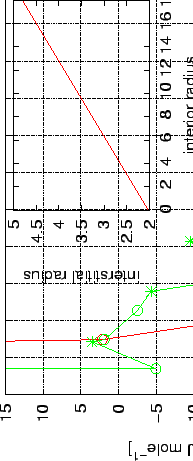
This effect is demonstrated on Figure 5.6, where the inside and outside interaction potentials are plotted against the radius of the nanotube's core.
graphene interlayer distance in graphite), the interstitial channels in a bundle depend only on the radius of the tube.
Each of these channels is surrounded by tree nanotubes and creates an interstice with negatively bent walls.
As noticed by Okamoto and Miyamoto [53] in comparison with the concave surface, the convex carbon surfaces notably manifest a weaker attraction for the hydrogen molecules.
This effect is demonstrated on Figure 5.6, where the inside and outside interaction potentials are plotted against the radius of the nanotube's core.
 |
 3 Å).
The nested plot on Fig. 5.6 shows the relation between the radius of different cavity types in the bundle.
Besides the negative curvature, the interstitial channels with very small diameters have particular topology.
This is caused by the undulations on the nanotube's wall, which are characteristic for nanotubes with small radius.
As a consequence, oscillations in the potential and attractive values have been found for interstitial channels with radius less than 2.5 Å (corresponds to bundles consisting of nanotubes with radius of 3.1 Å, see the nested plot in Fig. 5.6).
Both characteristics of the model produce a 3D potential in the interstitial channels with shape similar to a bulb condenser.
This effectively creates space ``pockets" between the nanotubes where the volume is enough to avoid the repulsion area of the potential.
These attractive regions emerge also as a consequence of the non-optimised mutual position of nanotubes in the bundle.
However, channels with radius
3 Å).
The nested plot on Fig. 5.6 shows the relation between the radius of different cavity types in the bundle.
Besides the negative curvature, the interstitial channels with very small diameters have particular topology.
This is caused by the undulations on the nanotube's wall, which are characteristic for nanotubes with small radius.
As a consequence, oscillations in the potential and attractive values have been found for interstitial channels with radius less than 2.5 Å (corresponds to bundles consisting of nanotubes with radius of 3.1 Å, see the nested plot in Fig. 5.6).
Both characteristics of the model produce a 3D potential in the interstitial channels with shape similar to a bulb condenser.
This effectively creates space ``pockets" between the nanotubes where the volume is enough to avoid the repulsion area of the potential.
These attractive regions emerge also as a consequence of the non-optimised mutual position of nanotubes in the bundle.
However, channels with radius  3 Å are expected to reduce the diffusion coefficient of molecular hydrogen [86] into the material and thus prevent the absorption processes in the bundle interstitial space.
Hence, the calculated values for the H2 storage capacities concerning structures with channel radius 3 Å should not be considered as realistic and should be interpreted with care when dealing with practical applications.
3 Å are expected to reduce the diffusion coefficient of molecular hydrogen [86] into the material and thus prevent the absorption processes in the bundle interstitial space.
Hence, the calculated values for the H2 storage capacities concerning structures with channel radius 3 Å should not be considered as realistic and should be interpreted with care when dealing with practical applications.
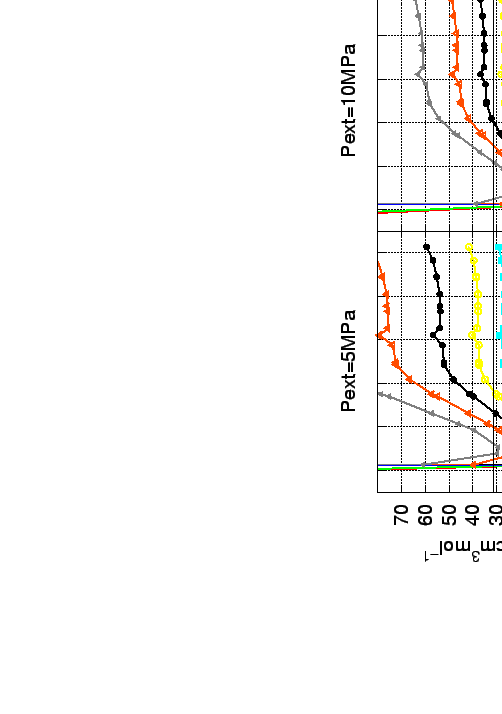
At 300 K and 5 MPa the bundles exercise almost twice the estimated storage capacities considered for the core of single nanotubes. However, the volumetric capacities at given temperature and pressure are nearly the same. The volumetric and mass ratio for representative temperatures and external H2 pressures are collected in Figure 5.7 and the corresponding interaction free energy and equilibrium constants on Fig. 5.8.
 |
3.5 Å, the second one appears for diameters in the range of 7-8 Å.
If the curves for the gravimetric and the volumetric capacities are superimposed with the curves for the interaction potential, it can be clearly seen that the second maximum appears for bundles where the strongest interactions are found to be in the interstitial channels, i.e. channels with a radius  3 Å.
However, according to the nested plot in Fig. 5.6 and ref. Y.M.2002, the bundles with interstitial space with radius smaller than 3 Å should be considered as impenetrable for hydrogen molecules.
Therefore, as a more realistic models for bundle of nanotubes are suggested those with radius greather than 6 Å (see nested plot on Fig. 5.6).
The ability, of both the interstitial and core nanotube sites (bundles consisting of nanotubes with radius 6-8 Å), to accommodate a reasonable amount of hydrogen gas leads to a plateau in the volumetric and gravimetric capacities.
As already suggested from Fig. 5.1, the core potential of nanotube with large diameter (
3 Å.
However, according to the nested plot in Fig. 5.6 and ref. Y.M.2002, the bundles with interstitial space with radius smaller than 3 Å should be considered as impenetrable for hydrogen molecules.
Therefore, as a more realistic models for bundle of nanotubes are suggested those with radius greather than 6 Å (see nested plot on Fig. 5.6).
The ability, of both the interstitial and core nanotube sites (bundles consisting of nanotubes with radius 6-8 Å), to accommodate a reasonable amount of hydrogen gas leads to a plateau in the volumetric and gravimetric capacities.
As already suggested from Fig. 5.1, the core potential of nanotube with large diameter ( 14 Å) mimics the graphene sheet model.
Therefore, it is expected that, in such systems, H2 molecules have higher density in the bundle's interstitial space, while for the interior of the nanotube the highest molecule density is located in the vicinity of the nanotube wall.
However, further enlarging of the nanotube radius (14 Å) will lead to interstitial cavities with diameter larger then 10 Å, where both the interstices and the nanotube cores will mimic the graphene sheet model.
14 Å) mimics the graphene sheet model.
Therefore, it is expected that, in such systems, H2 molecules have higher density in the bundle's interstitial space, while for the interior of the nanotube the highest molecule density is located in the vicinity of the nanotube wall.
However, further enlarging of the nanotube radius (14 Å) will lead to interstitial cavities with diameter larger then 10 Å, where both the interstices and the nanotube cores will mimic the graphene sheet model.
Lyuben Zhechkov 2007-09-04


