


Next: Graphite and fullerene modifications Up: SWCNTs and Carbon foams Previous: Bundles of nanotubes Contents
It has been demonstrated so far that  based carbon materials (consisting entirely of carbon atoms with hybridisation) have the potential to store a reasonable amounts of hydrogen gas.
However, it was found that the ability of the material to accommodate a certain amount of H2 molecules depends strongly on the width and the shape of the pores (see Chapter 3.2 and 5.1).
The hereby used simulation suggests also, that pores confined in the interior of a nanotube with diameters of 7-10 Å would be good sites for hydrogen physisorption.
On the other hand, the outer surface of the tube is an ineffective adsorption site (as explained at the end of the previous chapter) and makes the material inefficient for practical application.
The experimentally detected CIG material shows reasonable gravimetric storage capacities at moderate conditions (see Chapter 4). Though the gravimetric capacities are comparable, the carbon density in CIG is about 4.5 times higher, in comparison to the one in the hypothetical graphite with interlayer distance of 8 Å (Fig 4.3 and 3.2).
Thus, a reasonable question would be if it is possible to model and synthesise well defined periodic graphite-like structure, which combines low carbon density with pores or channels appropriate for hydrogen physisorption.
Indeed, models for such of carbon materials have been proposed originally by Karfunkel et al. and Balaban et al. in their theoretical works [87,88].
based carbon materials (consisting entirely of carbon atoms with hybridisation) have the potential to store a reasonable amounts of hydrogen gas.
However, it was found that the ability of the material to accommodate a certain amount of H2 molecules depends strongly on the width and the shape of the pores (see Chapter 3.2 and 5.1).
The hereby used simulation suggests also, that pores confined in the interior of a nanotube with diameters of 7-10 Å would be good sites for hydrogen physisorption.
On the other hand, the outer surface of the tube is an ineffective adsorption site (as explained at the end of the previous chapter) and makes the material inefficient for practical application.
The experimentally detected CIG material shows reasonable gravimetric storage capacities at moderate conditions (see Chapter 4). Though the gravimetric capacities are comparable, the carbon density in CIG is about 4.5 times higher, in comparison to the one in the hypothetical graphite with interlayer distance of 8 Å (Fig 4.3 and 3.2).
Thus, a reasonable question would be if it is possible to model and synthesise well defined periodic graphite-like structure, which combines low carbon density with pores or channels appropriate for hydrogen physisorption.
Indeed, models for such of carbon materials have been proposed originally by Karfunkel et al. and Balaban et al. in their theoretical works [87,88].
-carbon) segments.
The interconnection of these segments, by  carbon atoms, results in porous structures Fig. 5.9.
From a chemical point of view, the honeycomb structures may be also considered as connecting triptycyl moieties by benzene rings in two dimensions so that 2D hexagonal nets (with regular or irregular hexagons) emerge and then connect the identical nets by simple bonds.
The resulting ``foam'' structures cover the structural phase space extending from hexagonal diamond to graphite.
More recent theoretical studies [89,90] have shown that this hybrid system possesses unusually high structural stability (comparable to that of diamond) combined together with low mass density.
The stability of this carbon material is attributed to the absence of bent surfaces.
Since the graphene fragments are interconnected with carbon atoms they nearly mimic the tetrahedral coordination in diamond.
On the other hand, they possess the characteristics of both the nanotube bundles and the hypothetical graphene sheet model.
Moreover, the shape and size of their pores can be controlled by altering the number of hexagon rings on each wall, therefore their variety is almost unlimited.
carbon atoms, results in porous structures Fig. 5.9.
From a chemical point of view, the honeycomb structures may be also considered as connecting triptycyl moieties by benzene rings in two dimensions so that 2D hexagonal nets (with regular or irregular hexagons) emerge and then connect the identical nets by simple bonds.
The resulting ``foam'' structures cover the structural phase space extending from hexagonal diamond to graphite.
More recent theoretical studies [89,90] have shown that this hybrid system possesses unusually high structural stability (comparable to that of diamond) combined together with low mass density.
The stability of this carbon material is attributed to the absence of bent surfaces.
Since the graphene fragments are interconnected with carbon atoms they nearly mimic the tetrahedral coordination in diamond.
On the other hand, they possess the characteristics of both the nanotube bundles and the hypothetical graphene sheet model.
Moreover, the shape and size of their pores can be controlled by altering the number of hexagon rings on each wall, therefore their variety is almost unlimited.
For the sake of simplicity the discussed structures include only the highest symmetry carbon foams e.g. their interconnected graphene segments have always nearly the same size0.55.3. This way, the width of carbon foam pores can be approximated to a cylinder with diameter the distance between the two opposite walls of the channel, thus a comparison with the nanotube models is easier.
The unit cell parameters used in the simulations have been taken from recent investigation on that topic [90].
The contribution to the potential in the simulated box has been taken from the 15 adjacent unit cells (by 15 on the left and right hand) along the channel axis and by 5 in the other two directions0.55.4.
The contribution of the carbon atoms to the total interaction potentials has been calculated in two ways since they are expected to have weaker H2 attractive capabilities0.55.5.
In the first case their contributions have been completely neglected, while in the second one the assigned interaction potential was the same as for the other carbon atoms.
However, it has been found that this does not change sensibly neither the potential energy surface, nor affect the convergence of the equilibrium constant.
Therefore, the contributions from the C atoms have been taken as if they were C
 atoms.
A comparison between the potential energy surfaces of nanotube cores and carbon foam pores with respect to the radius of their channels shows similar values in the potential well depth Fig. 5.10.
 |
 7 Å have constant values (see Fig. 5.10).
However, a closer look into the 3D-potential energy surface (5.11) gives a better understanding of this behaviour.
7 Å have constant values (see Fig. 5.10).
However, a closer look into the 3D-potential energy surface (5.11) gives a better understanding of this behaviour.
The figure shows two carbon foam structures, which differ from each other by the width of their pores i.e. the number of hexagon rings perpendicular to the channel axis.
Since the radius increases with the number of rings the potential in the middle of the cavity becomes weaker (similarly to nanotube's potential).
However, the coordination and the bond angles of the carbon atoms remain the same.
The contribution to the interaction potential in the regions of the carbon atoms is given by the overlapping potentials of atoms located around the corners.
Since the enlargement of the cavity do not influence the geometry and the number of C atoms in the vicinity of the corners, the interaction potential on these sites is constant.
This constant interaction potential emerges as tiny cones in the corners of the hexagons as demonstrated on Fig. 5.11 (Right).
atoms in the vicinity of the corners, the interaction potential on these sites is constant.
This constant interaction potential emerges as tiny cones in the corners of the hexagons as demonstrated on Fig. 5.11 (Right).
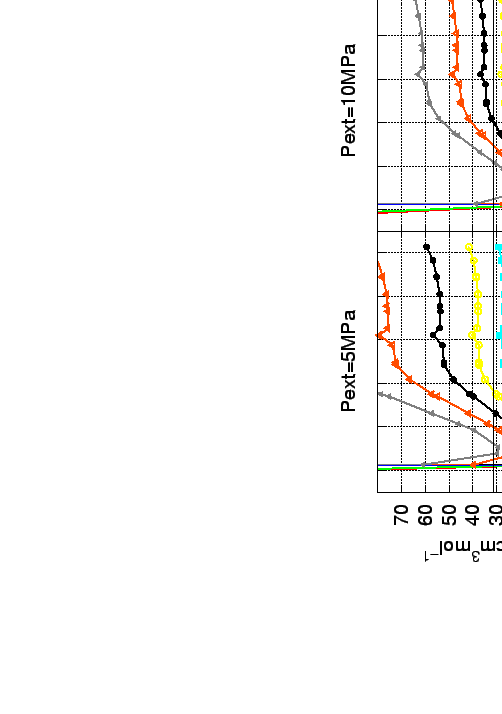
Beside this particular characteristic of the carbon foams they closely mimic the gravimetric storage capacity of nanotubes even for relatively large pore size (Fig. 5.7 and 5.12).
 |
 , the only molecules attracted efficiently in larger cavities will be those on the surfaces and in the corners.
Moreover, the reduced density of Catom (and hence number of carbon contributions to the potential) in the material leads to significant decrease of the interaction energy in the core of the channels.
, the only molecules attracted efficiently in larger cavities will be those on the surfaces and in the corners.
Moreover, the reduced density of Catom (and hence number of carbon contributions to the potential) in the material leads to significant decrease of the interaction energy in the core of the channels.
The H2 density in the material, is a function of the ``internal'' pressure ( ) at temperature T.
It is related to the equilibrium constant
) at temperature T.
It is related to the equilibrium constant  (at the same temperature) with Eq. 3.1, which gives the increase of the pressure with respect to the one outside of the material.
Hence, the ``internal'' pressure is a direct indication for the abilities of the material to naturally compress hydrogen gas.
Respectively
(at the same temperature) with Eq. 3.1, which gives the increase of the pressure with respect to the one outside of the material.
Hence, the ``internal'' pressure is a direct indication for the abilities of the material to naturally compress hydrogen gas.
Respectively  gives the strength of H2material binding.
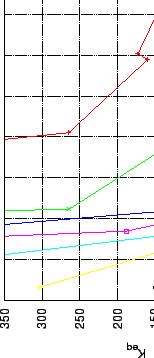
Figures 3.4, 5.8 and 5.13 represent and values for
gives the strength of H2material binding.
Figures 3.4, 5.8 and 5.13 represent and values for
 |
graphene systems.
As can be clearly seen for the optimum sized pores (width of 6 to 8 Å) the highest and values are found for nanotubes followed by carbon foams and layered graphene system.
The increase of the pore's width always leads to a fast decreasing of the equilibrium constant and the corresponding interaction free energies.
The is a ratio between the binding states and all the possible states in the system.
Since the number of the calculated states is kept almost constant, it can be suggested that the number of binding states decrease considerably.
Therefore, the increase of cavity radius in carbon foams results in decrease of the H2 density.
However, the potential of the carbon foams with optimal size and well defined pores are good candidates for a storage material.
Because of their cristal-like structure they are much more reliable material than the nanotube bundles and in the same time they reach the same gravimetric and volumetric capacities.


