Next: Empiric entropy estimation Up: Interaction potential Previous: Many H-PAH interactions Contents

 C
C Potential
The contributions from the hexagon ring of infinite graphene platelet to the total potential energy surface are equivalent.
Therefore it can be considered that the contribution of each sp carbon atom is six times smaller than the contribution of a six member ring.
Nevertheless, direct ab initio evaluation of the sufficiently detailed potential energy surface of a graphene platelet is prohibitively expensive.
Instead, the H2graphene PES is described not by the equation 2.1, but by the exp
carbon atom is six times smaller than the contribution of a six member ring.
Nevertheless, direct ab initio evaluation of the sufficiently detailed potential energy surface of a graphene platelet is prohibitively expensive.
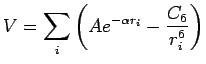
Instead, the H2graphene PES is described not by the equation 2.1, but by the exp form of the Lenard-Jones (LJ) H2C pair (see Eq. 1.14), where
  is the distance between H2 centre of mass and carbon atom
  .
Hence, the evaluation of the interaction potential for graphene platelet turns simply to a sum over all the carbon centres:
.
Hence, the evaluation of the interaction potential for graphene platelet turns simply to a sum over all the carbon centres:
 ,
,  , and
, and
 are fitted to reproduce the MP2/cc-pVTZ results of the
  symmetric
H2benzene and H2coronene model system (see 2.4).
C6H6' curve which lies very close to the Coupled Cluster `H2C6H6' values (see Fig. 2.7).
In other words, besides the reasonable performance of the the MP2/cc-pVTZ level of theory, when enlarging the model system (e.g adding more atoms to the model) a better description of the potential interaction can be achieved.
symmetric
H2benzene and H2coronene model system (see 2.4).
C6H6' curve which lies very close to the Coupled Cluster `H2C6H6' values (see Fig. 2.7).
In other words, besides the reasonable performance of the the MP2/cc-pVTZ level of theory, when enlarging the model system (e.g adding more atoms to the model) a better description of the potential interaction can be achieved.
 |
 mol
mol ) the translational
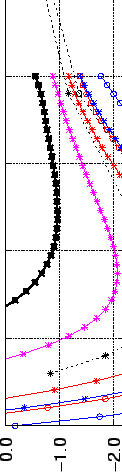
barriers between two adjacent minima (Fig. 2.8).
) the translational
barriers between two adjacent minima (Fig. 2.8).
|
 and is therefore not expected to affect the thermodynamical properties.
The three types of parameters (one fitted to benzene CCSD(T)/cc-pVTZ and the others fitted to coronene and benzene MP2/cc-pVTZ calculations) have been compared with an empirical potential.
In Figure 2.9, it is shown that they slightly overestimate the experimental values.
Considering the fact that the ab initio calculations completely neglect the thermodynamical conditions of the experiment in general, the fits may be taken as realistic.
Therefore the so derived parameters are used further (see Chapter 1) to evaluate periodic graphene-like structures with experimental or quantum mechanically computed CC bond lengths (
and is therefore not expected to affect the thermodynamical properties.
The three types of parameters (one fitted to benzene CCSD(T)/cc-pVTZ and the others fitted to coronene and benzene MP2/cc-pVTZ calculations) have been compared with an empirical potential.
In Figure 2.9, it is shown that they slightly overestimate the experimental values.
Considering the fact that the ab initio calculations completely neglect the thermodynamical conditions of the experiment in general, the fits may be taken as realistic.
Therefore the so derived parameters are used further (see Chapter 1) to evaluate periodic graphene-like structures with experimental or quantum mechanically computed CC bond lengths ( ).
).